

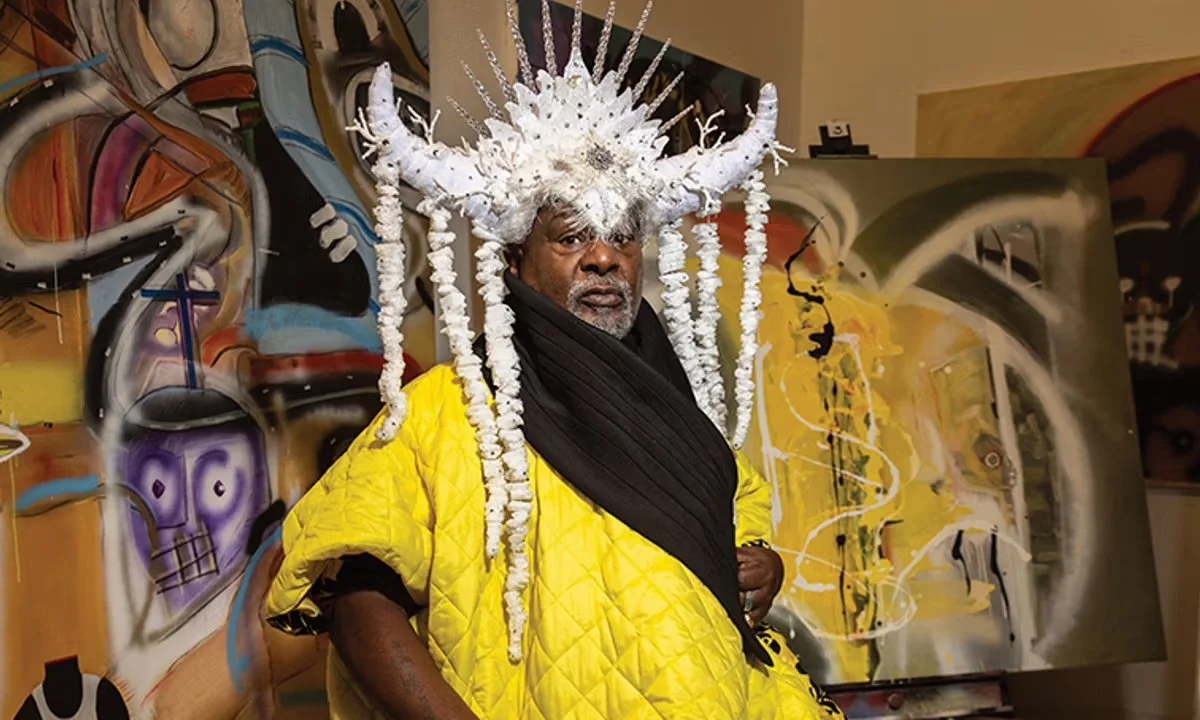
GEORGE CLINTON
Fall 2022

George Clinton stands as the principal architect of what is now understood as P-Funk—an expansive articulation of Blackness grounded in the groove. As a songwriter, producer and performer, his trajectory moves from Doo Wop in New Jersey, through Motown’s assembly-line songwriting culture, toward a deliberate embrace of the freedoms emerging at the intersection of counterculture, psychedelia, and Black Liberation.
Attuned to the frequencies of contemporaries similarly extending the form, James Brown, Sly Stone, and jazz’s Sun Ra’s intergalactic Astro-Black vision, Clinton constructed a distinct cosmic framework through Parliament-Funkadelic. P-Funk entered the public sphere with an infectious groove, extended improvisational live sets, and a layered visual language shaped in collaboration with Pedro Bell. The presentation carried elements of spectacle, satire, and coded politics—world-building at a high level.
Parliament-Funkadelic operated less as a band than as a collective of sonic researchers, moving through territories largely uncharted within mainstream funk. Numerous satellite groups emerged from this central nucleus—Brides of Funkenstein, Bootsy’s Rubber Band, Parlet—each receiving recognition while contributing to the broader ecosystem. Within this structure, figures such as Bernie Worrell expanded the sonic field through early adoption of synthesizer technologies, introducing new timbral dimensions to an already vivid palette.
The Mothership Connection tour remains a defining moment: a custom spacecraft descending onto the stage, collapsing the distance between performance and myth. In that gesture, ideas now gathered under Afrofuturism were made materially present, not as abstraction but as lived experience.
Atomic Dog marked another inflection point. Drawn from Clinton’s capacity to rework constraint into possibility, the track articulated a new direction for funk within the experimental landscape of Black popular music in the 1980s.
Clinton’s business strategies were equally prescient. His embrace of sampling, evident in the release of Sample Some of Disc, Sample Some of DAT, anticipated the needs of emerging producers, offering access and clearance pathways that would feed directly into the formation of what is now called G-Funk.
Clinton and core members continue to record and collaborate across generations, from The Red Hot Chili Peppers to Flying Lotus, maintaining an active presence within evolving musical dialogues.
During our Blacktronika interview, Dr. Clinton joined us between tour dates and engaged the room with depth and attentiveness. He watched the lecture, listened closely, and met the students with openness. The exchange carried weight—an artist fully present within his legacy, and still extending it.